
A meticulously organized medical writing workspace without any people, featuring an open silver laptop displaying a clean, text-based regulatory document layout on a large, matte-finish monitor beside it. The desk is a smooth light-wood surface with a slim black keyboard, a fountain pen resting on a printed protocol draft, and neatly stacked binders labeled “Protocols,” “CSRs,” and “Regulatory Strategy.” In the background, softly blurred shelves hold scientific reference books and a discreet model of a double helix. Soft daylight from an unseen window to the left creates gentle highlights on the laptop edges and casts calm, directional shadows. Photographic realism, captured at eye level with a shallow depth of field, conveys a professional, focused, and trustworthy atmosphere suitable for a regulatory medical writing consultancy homepage.

Therapeutic Focus

Comprehensive support across key therapeutic areas, core clinical documents, and global FDA/EMA submission pathways.

Expertise

I provide PhD-level regulatory medical writing across oncology, immunology, neurology, and rare diseases, specializing in protocols, CSRs, IBs, safety narratives, and CTD modules aligned with FDA, EMA, and global authority expectations.

A modern, quiet conference room designed for biotech and pharmaceutical consulting meetings, entirely empty of people. At the center is a long, matte white table with three open folders labeled “Biotech,” “Pharma,” and “Medical Devices,” each containing neatly arranged printed charts and structured text. A large wall-mounted screen at the far end displays an out-of-focus regulatory submission timeline in muted blues and greys. Floor-to-ceiling windows on one side allow soft, overcast daylight to fill the room, creating gentle reflections on the table’s surface. Minimalist chairs with dark fabric line the table, slightly out of focus. Photographic realism captured from a slightly low, wide-angle perspective emphasizes clarity, organization, and strategic planning in a calm, professional atmosphere.

Regulatory Frameworks and Guideline Expertise

Experienced with ICH E6 and E3, GCP, CONSORT, FDA and EMA guidance, and regional agency expectations for clinical trial documentation.
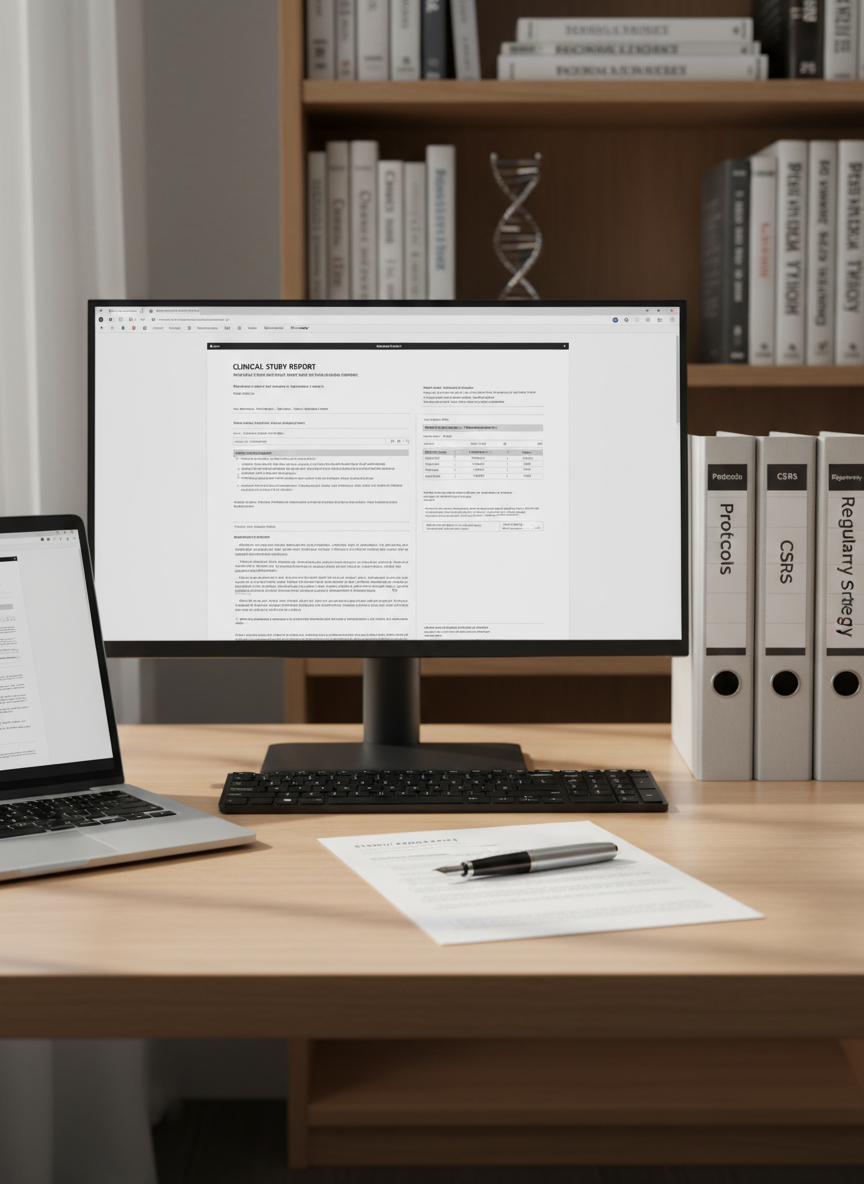

A meticulously organized medical writing workspace without any people, featuring an open silver laptop displaying a clean, text-based regulatory document layout on a large, matte-finish monitor beside it. The desk is a smooth light-wood surface with a slim black keyboard, a fountain pen resting on a printed protocol draft, and neatly stacked binders labeled “Protocols,” “CSRs,” and “Regulatory Strategy.” In the background, softly blurred shelves hold scientific reference books and a discreet model of a double helix. Soft daylight from an unseen window to the left creates gentle highlights on the laptop edges and casts calm, directional shadows. Photographic realism, captured at eye level with a shallow depth of field, conveys a professional, focused, and trustworthy atmosphere suitable for a regulatory medical writing consultancy homepage.
A close-up, photographic realistic still life of regulatory documents spread across a sleek dark-grey desk, with no people present. A detailed clinical study protocol, safety narrative, and CSR synopsis are visible, their headings and structured sections clear but non-legible. A matte black pen rests diagonally across the top document, next to a pair of understated, rimless glasses folded neatly. A tablet device lies off to the side, showing a blurred dashboard of timelines and milestones. Cool, diffused overhead lighting softly illuminates the paper textures and creates subtle reflections on the tablet screen. Shot from a slightly elevated angle with balanced composition, the scene feels precise, methodical, and highly professional, emphasizing accuracy and structure in regulatory medical writing.
An elegant, photographic realistic overhead view of a clinical documentation planning scene on a pale oak desk, with no human presence. Color-coded sticky notes arranged in a clear sequence spell out phases like “Protocol,” “CSR,” “Safety Narratives,” and “Regulatory Responses,” surrounding a central, closed navy-blue notebook embossed with a subtle caduceus symbol. A slim silver laptop sits to one side, screen just visible with a blurred project plan. A ceramic cup of herbal tea on a white saucer adds a touch of calm. Soft morning light from the top of the frame washes across the desk, creating gentle shadow gradients and a serene, organized atmosphere. The composition uses rule of thirds with sharp focus throughout, evoking meticulous planning and structured thinking in medical writing projects.